

Why Small Businesses Are the Partners Small Charities Actually Need
)
There's a common assumption that supporting charities is something you do once you're big. Once there's a CSR budget, a foundation, someone whose actual job it is. It's a comfortable assumption, but it's wrong.
Most Australian charities are small. The ACNC's Australian Charities Report draws on data from more than 53,000 registered charities, and the same pattern shows up every year: over half operate with no paid staff at all, and among the smallest, close to 90% run entirely on volunteers. These are organisations doing serious frontline work with a handful of people and a website someone built in 2016.
That's not a plea for sympathy. It's a market signal. The gap between what a small charity needs and what it can buy is exactly the gap a small business is well placed to close.
Being small is an advantage here
Large corporate partnerships are typically slower. Procurement, brand approvals, three months to sign off on one day of volunteering. You don't have that problem. You can decide on Tuesday and be useful by Thursday.
You're also a peer. A business with six staff and a charity with six staff understand each other's constraints instinctively - no budget for the good version of the software, no one to take on the thing that isn't anyone's job. That shared reality makes for better conversations and better outcomes than a formal program ever will.
Start with what they actually need
Infoxchange's Digital Technology in the Not-for-Profit Sector report, which surveyed more than 800 organisations, is a useful reality check. Budget pressure remains the sector's biggest barrier. Only 31% rate their organisation's data capability as strong. Two-thirds now use generative AI, but 85% have no AI policy, and fewer than a quarter have a documented cyber security plan.
Translation: the need is rarely a grand transformation. It's someone to untangle the CRM, write a sensible AI policy, fix a donation form that drops people at checkout, or set up multi-factor authentication and show the team how it works. Operational, unglamorous, high-value. Exactly the kind of thing a working professional can do well in a few focused hours.
Five ways in - pick one
- Skilled time. Your finance, marketing, HR, ops or IT expertise, applied to a scoped piece of work. This is the highest-leverage thing most small businesses can offer.
- Mentoring. Charity and impact-led business leaders often carry the whole organisation without a peer to think out loud with. An hour a month is genuinely valuable.
- Product. Free or discounted access to what you already sell. Low cost to you, immediate benefit to them.
- Money, structured. Pledge 1% gives you a free, flexible framework to commit 1% of profit, product, equity or staff time. It also puts you in a global network of businesses doing the same thing.
- Your customers. Platforms like Tap4Change let customers donate to a cause they care about and receive a thank-you offer from your business, giving smaller charities visibility they'd never buy.
Four rules that separate helpful from well-meaning
- Ask before you offer. The thing you most want to give is not always the thing they most need.
- Scope it like a real project. One deliverable, one date, one point of contact on each side.
- Leave capability behind, not dependency. Document it, train someone, hand over the logins. Support that outlasts your involvement is worth far more than support that ends when you get busy.
- Commit to less than you think, then keep going. A small thing sustained beats a big thing abandoned.
Most of this starts in a room
Very few of these partnerships begin with a formal enquiry. They begin with a conversation at an event, a mutual connection, someone mentioning what they're stuck on.
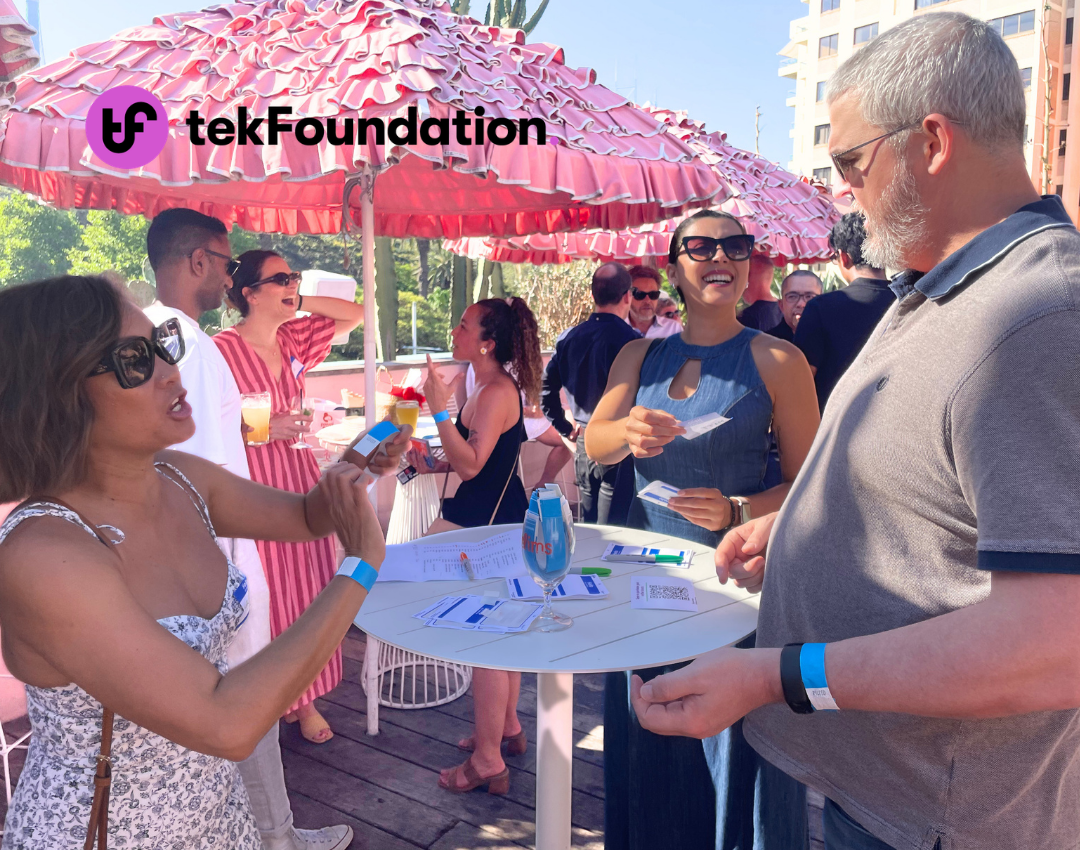
That's the real argument for showing up - at The Business Show, at industry meetups, at community events like our own Tech for Good Happy Hours in Sydney. Turn up a few times and the people and ideas find you.
About tekFoundation
tekFoundation is an Australian charity and a digital capability engine for community impact. We connect charities with skilled tech volunteers and corporate partners, and back them year-round with scoped projects, peer community and practical learning - so capability outlasts any single project. Since 2023 we've matched 55+ charities with skilled volunteers, with 2,000+ hours of expertise donated by 70+ volunteers and over $320,000 of value delivered through digital services.
If your business wants to get involved, talk to us about partnering.